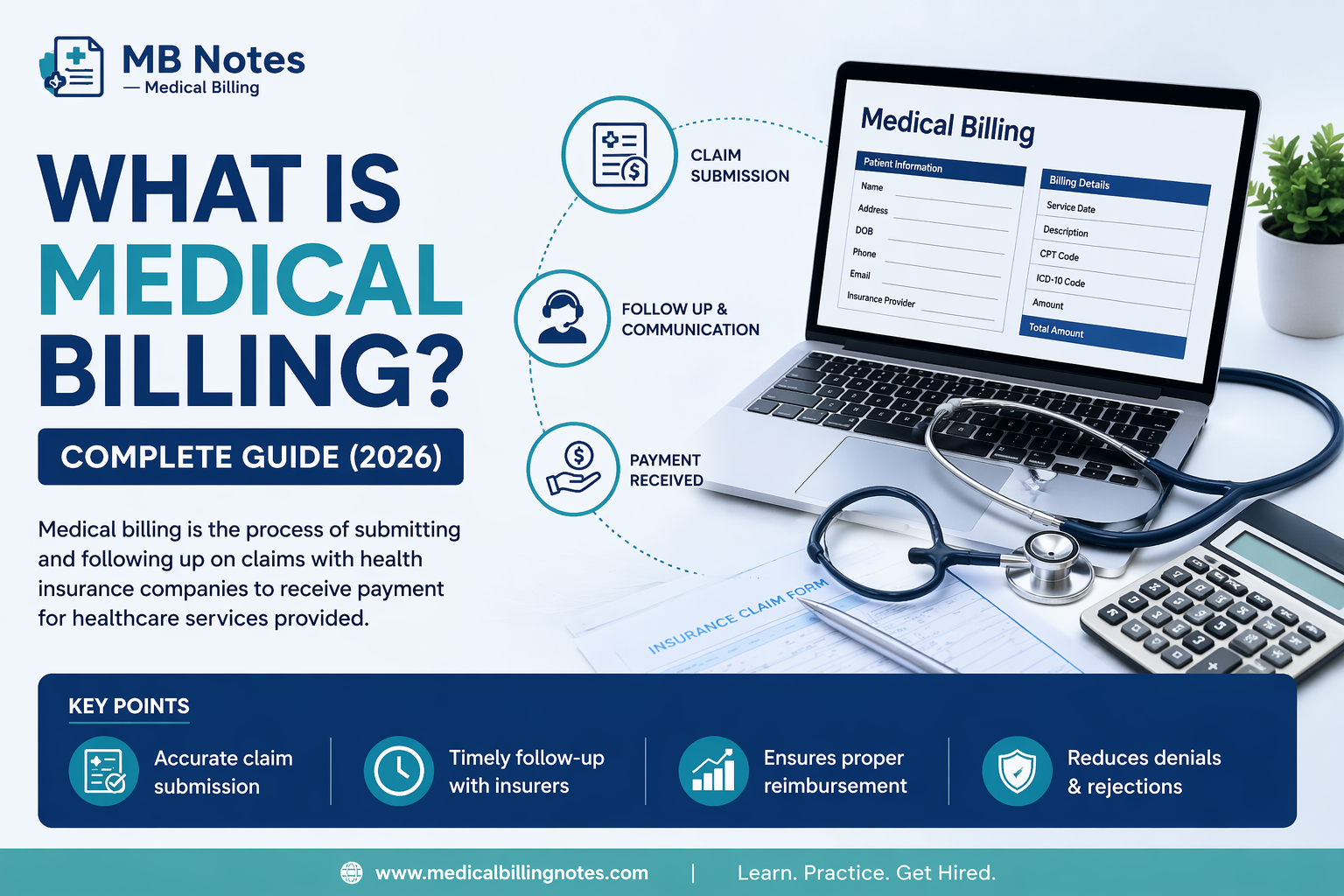
Medical billing is the process of converting healthcare services into standardized claims and submitting them to insurance companies or patients for payment. Its primary use is to ensure that healthcare providers—hospitals, clinics, and physicians—are properly reimbursed for the services they deliver. Without medical billing, there would be no structured way to track treatments, generate revenue, or maintain financial stability in the healthcare system
The importance of medical billing lies in its direct impact on cash flow and operational efficiency. Accurate billing reduces claim denials, speeds up reimbursements, and ensures compliance with healthcare regulations. In countries like the United States, where insurance systems are complex, proper billing is critical to avoid revenue loss. In Asia and the Middle East, where healthcare systems may involve a mix of insurance and self-pay patients, billing ensures transparency and proper financial management. Overall, it acts as a bridge between healthcare providers, insurance companies, and patients.
To take care of medical billing effectively, billing agents or companies must focus on accuracy, compliance, and timely processing. This includes correct patient registration, thorough insurance verification, proper coding (ICD and CPT), and clean claim submission. Regular follow-ups on denied or pending claims (Accounts Receivable) are essential to maximize collections. Maintaining up-to-date knowledge of payer rules and regulations is also crucial. Additionally, using efficient billing software, conducting audits, and ensuring clear communication with providers and patients can significantly improve performance and reduce errors. A disciplined and detail-oriented approach is key to successful medical billing operations.
What is Medical Billing?
Medical billing is the process of submitting claims to insurance companies to receive payment.
Patient Registration
Insurance Verification
Claim Submission
Payment Posting
👉 Why is Medical Billing Important?
Ensures healthcare providers get paid
Reduces claim denials
Improves revenue cycle management
🧾 PATIENT REGISTRATION (Front Desk Process)
Definition: Patient Registration is the first step in the medical billing cycle, where patient demographic and insurance details are collected.
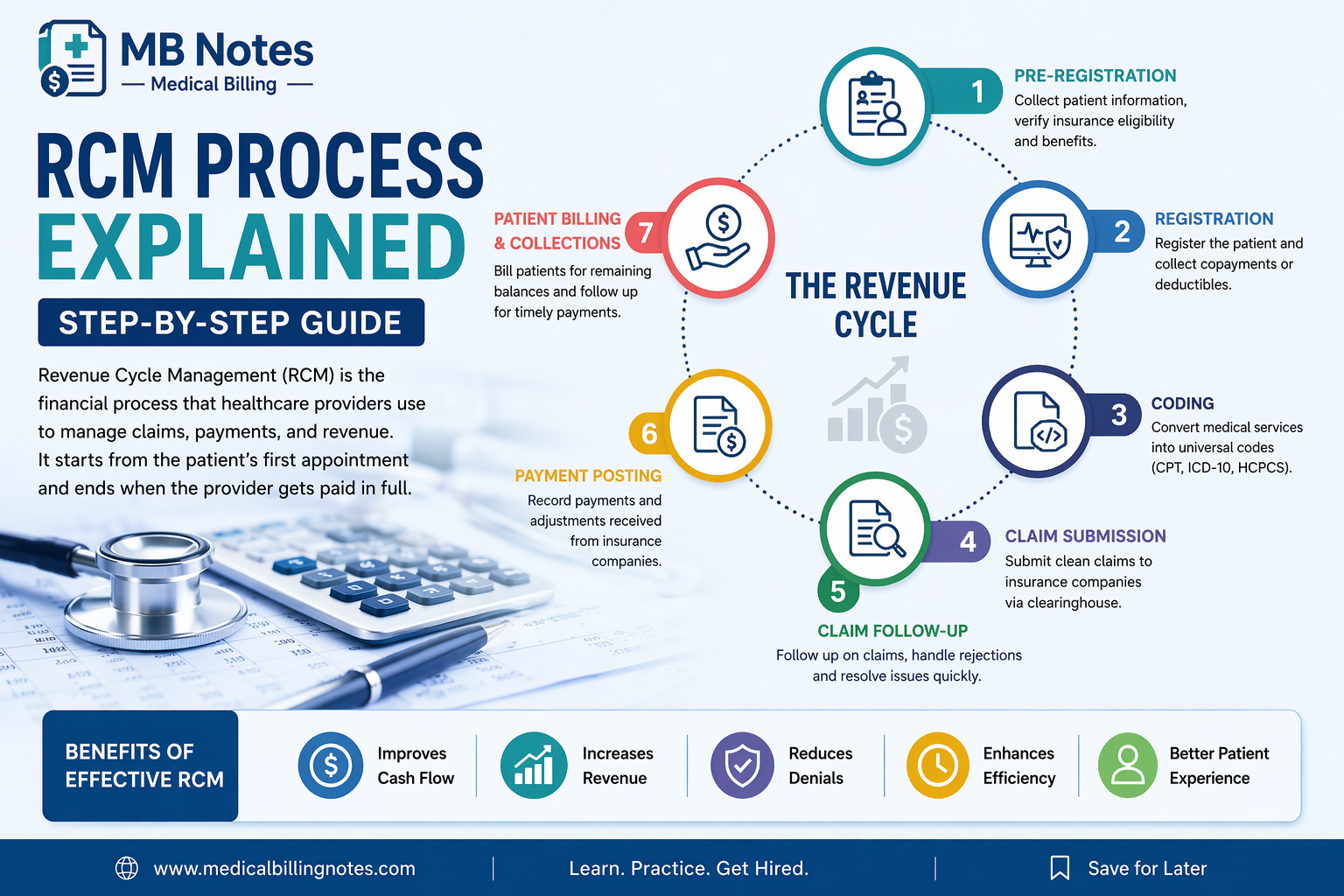
Revenue Cycle Management (RCM) is the process used by healthcare providers to manage the financial lifecycle of a patient—from appointment scheduling and registration to final payment collection. The main use of RCM is to ensure that healthcare services are accurately documented, billed, and reimbursed by insurance companies or patients. It connects clinical operations with financial outcomes, helping hospitals and clinics maintain a steady cash flow while delivering quality care.
The importance of RCM lies in its direct impact on revenue, compliance, and operational efficiency. In complex systems like the United States, RCM ensures adherence to strict insurance guidelines and reduces claim denials. In regions such as Asia and the Middle East, where there is a mix of insurance and self-pay patients, RCM helps maintain transparency and financial control. A strong RCM process improves clean claim rates, reduces delays in payment, and enhances patient satisfaction by minimizing billing errors.
To take care of medical billing effectively, billing agents or companies must focus on accuracy, timeliness, and compliance. This includes proper patient registration, thorough insurance verification, correct coding using ICD and CPT standards, and clean claim submission. Regular follow-up on denied or pending claims is essential to maximize collections. Staying updated with payer rules, using reliable billing software, and conducting internal audits can significantly improve performance. Clear communication with healthcare providers and patients also plays a key role. A disciplined and detail-oriented approach ensures successful RCM and long-term financial stability.
What is RCM :
RCM is the financial process from registration to payment.
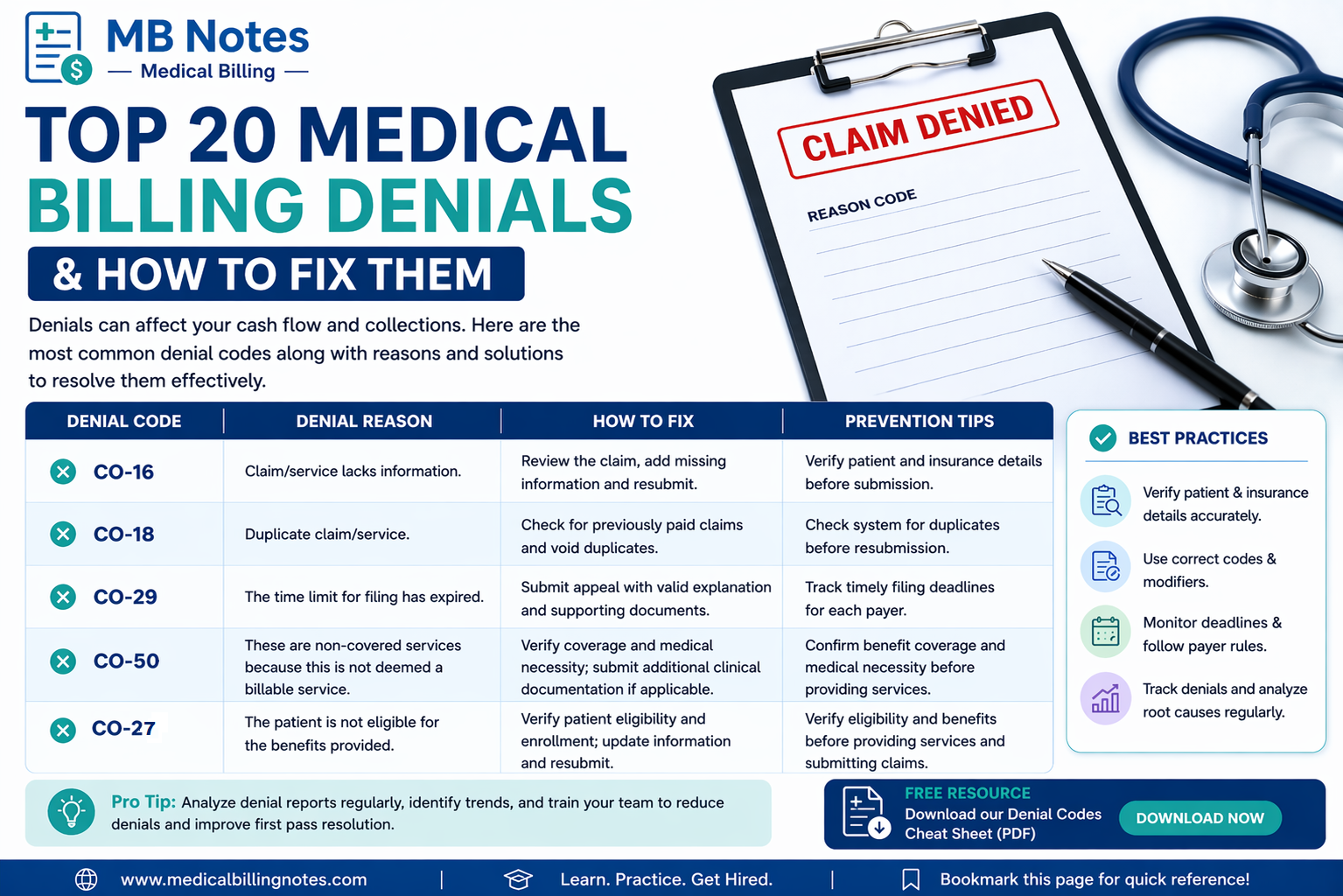
Top Medical Billing Denials & Fixes” refers to the most common reasons insurance companies reject or deny claims—and the practical steps used to resolve and prevent them. The most frequent denials include incorrect patient information, inactive or ineligible insurance coverage, missing prior authorization, coding errors (ICD/CPT mismatch), and duplicate or late claim submissions. For example, if a claim is denied due to “coverage terminated,” the fix involves verifying eligibility dates, correcting records, and resubmitting. If denied for coding errors, the coder must review documentation and update the correct codes before resubmission.
Understanding these denials is extremely important because they directly impact a provider’s revenue and cash flow. In the United States, denial rates can significantly reduce profitability if not managed properly. In Asia and the Middle East, where healthcare systems may combine insurance and out-of-pocket payments, denials can delay collections and create patient dissatisfaction. A high denial rate also increases administrative workload and slows down the revenue cycle. Therefore, reducing denials improves financial stability, speeds up reimbursements, and enhances operational efficiency.
To effectively manage medical billing, billing agents and companies must adopt a proactive and detail-oriented approach. First, ensure accurate patient registration and thorough insurance verification before services are provided. Second, maintain high-quality coding practices by regularly training staff and following updated guidelines. Third, use claim scrubbing tools to catch errors before submission. Fourth, track denials through reports and identify root causes to prevent recurrence. Finally, implement a strong Accounts Receivable (A/R) follow-up process to quickly resolve and reprocess denied claims. Clear communication with payers and patients, along with continuous monitoring of KPIs like denial rate and clean claim rate, is essential for long-term success in medical billing operations.
Here are the top Medical billing denials and how we can fix following this steps.
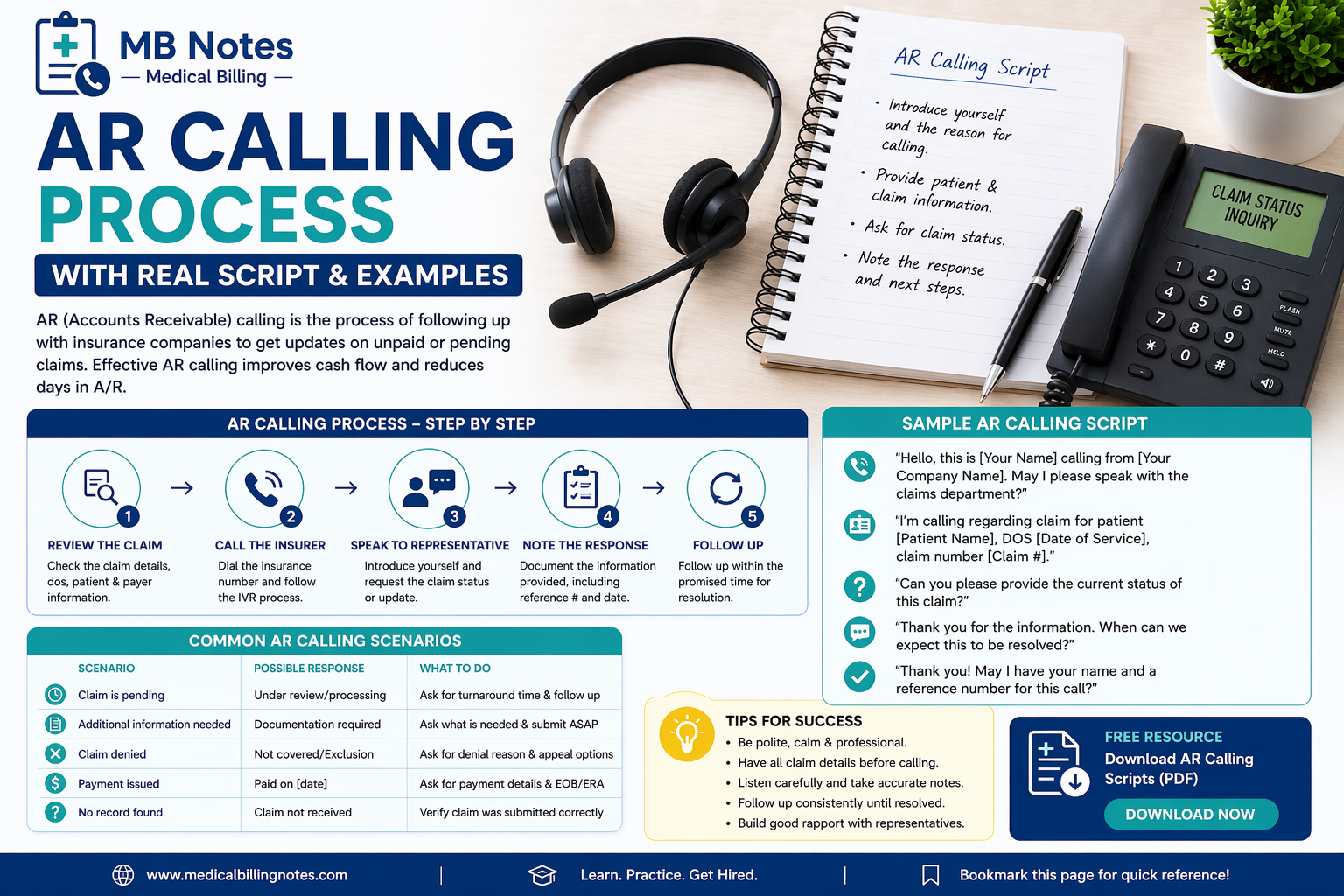
Accounts Receivable (A/R) Calling Process is a critical step in medical billing where representatives contact insurance companies (and sometimes patients) to follow up on unpaid or denied claims. The goal is to identify the reason for non-payment, resolve issues, and ensure timely reimbursement. The process typically begins by reviewing the claim status in the billing system or payer portal, then calling the insurance company with key details such as patient name, date of service, and claim number. The caller verifies claim status, understands denial reasons (if any), documents the response, and takes appropriate action—such as correcting errors, resubmitting claims, or initiating an appeal.
The importance of A/R calling lies in its direct impact on revenue recovery and cash flow. Even a perfectly submitted claim can be delayed or denied due to payer-side issues. Without proper follow-up, these claims may remain unpaid, leading to revenue loss. In the United States, where insurance processes are complex, A/R calling is essential to manage denials and aging claims. In Asia and the Middle East, where systems may vary between insurance and self-pay, A/R ensures collections are completed efficiently. It also helps reduce A/R days, improve collection rates, and maintain financial stability for healthcare providers.
To manage medical billing effectively as an A/R caller or billing company, a structured and disciplined approach is required. Always verify claim details before calling, maintain clear and professional communication with payers, and document every interaction accurately. Understand common denial codes and payer guidelines to provide quick resolutions. Prioritize high-value and aging claims, and follow escalation protocols when needed. Use reporting tools to track performance metrics like denial rate and collection efficiency. Continuous training, attention to detail, and proactive follow-ups are key to success in A/R calling and overall medical billing operations.
What is A/R Calling?
Definition: A/R Calling is the process of contacting insurance companies to follow up on unpaid, denied, or pending claims
👉 Simple meaning: “You call insurance to get payment released.”
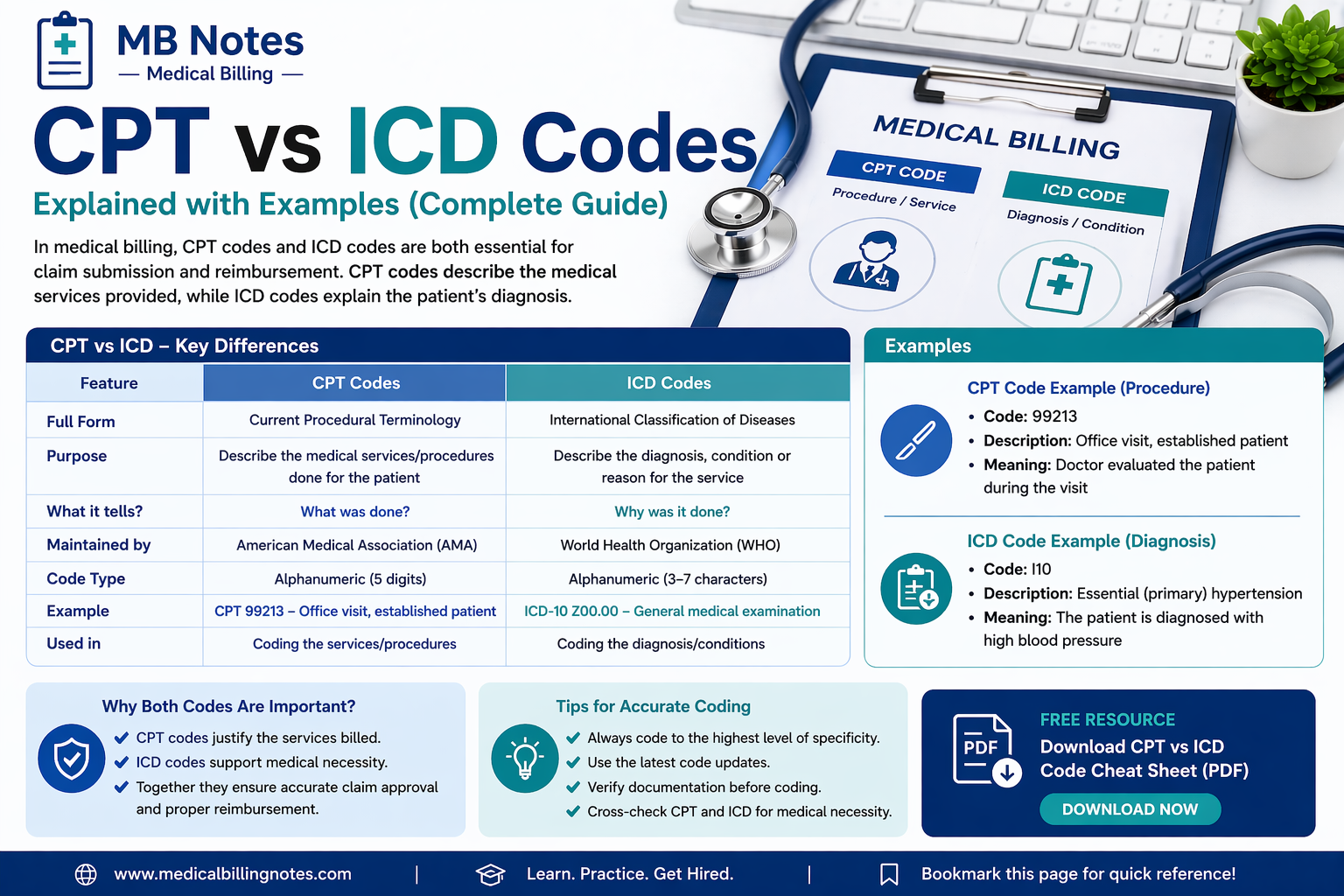
CPT and ICD codes are the foundation of medical billing and Revenue Cycle Management (RCM). ICD (International Classification of Diseases) codes describe the patient’s diagnosis—why the patient received care. For example, diabetes or hypertension is captured using ICD codes. In contrast, CPT (Current Procedural Terminology) codes describe the services or procedures performed by the provider—what was done, such as a consultation, lab test, or surgery. Together, CPT and ICD codes create a complete picture for insurance companies to understand and reimburse healthcare services.
The importance of CPT vs ICD coding lies in ensuring medical necessity and accurate reimbursement. Insurance payers, especially in the United States under programs governed by the Centers for Medicare & Medicaid Services, require that the diagnosis (ICD) supports the procedure (CPT). If there is a mismatch—for example, a minor diagnosis linked to a major surgical procedure—the claim will likely be denied. In Asia and the Middle East, where healthcare systems are increasingly adopting insurance-based models, proper coding also ensures transparency, compliance, and faster payments.
To manage medical billing effectively, billing agents, A/R callers, and billing companies must focus on accuracy and compliance. This includes carefully reviewing physician documentation, assigning the correct ICD and CPT codes, and ensuring proper linkage between them. Using coding guidelines, payer policies, and claim scrubbing tools can reduce errors before submission. In case of denials, A/R teams should analyze whether the issue is due to coding mismatch and take corrective actions such as updating codes or submitting appeals. Continuous training, audits, and staying updated with coding changes are essential. Ultimately, accurate CPT and ICD usage leads to fewer denials, improved cash flow, and efficient healthcare revenue management.
🧾 1. What are ICD Codes?
Definition: ICD (International Classification of Diseases) codes describe the patient’s diagnosis (WHY the patient is sick).
👉 Example:
Fever → ICD: R50.9
Diabetes → ICD: E11.9
🛠️ 2. What are CPT Codes?
Definition: CPT (Current Procedural Terminology) codes describe the treatment/service provided (WHAT doctor did).
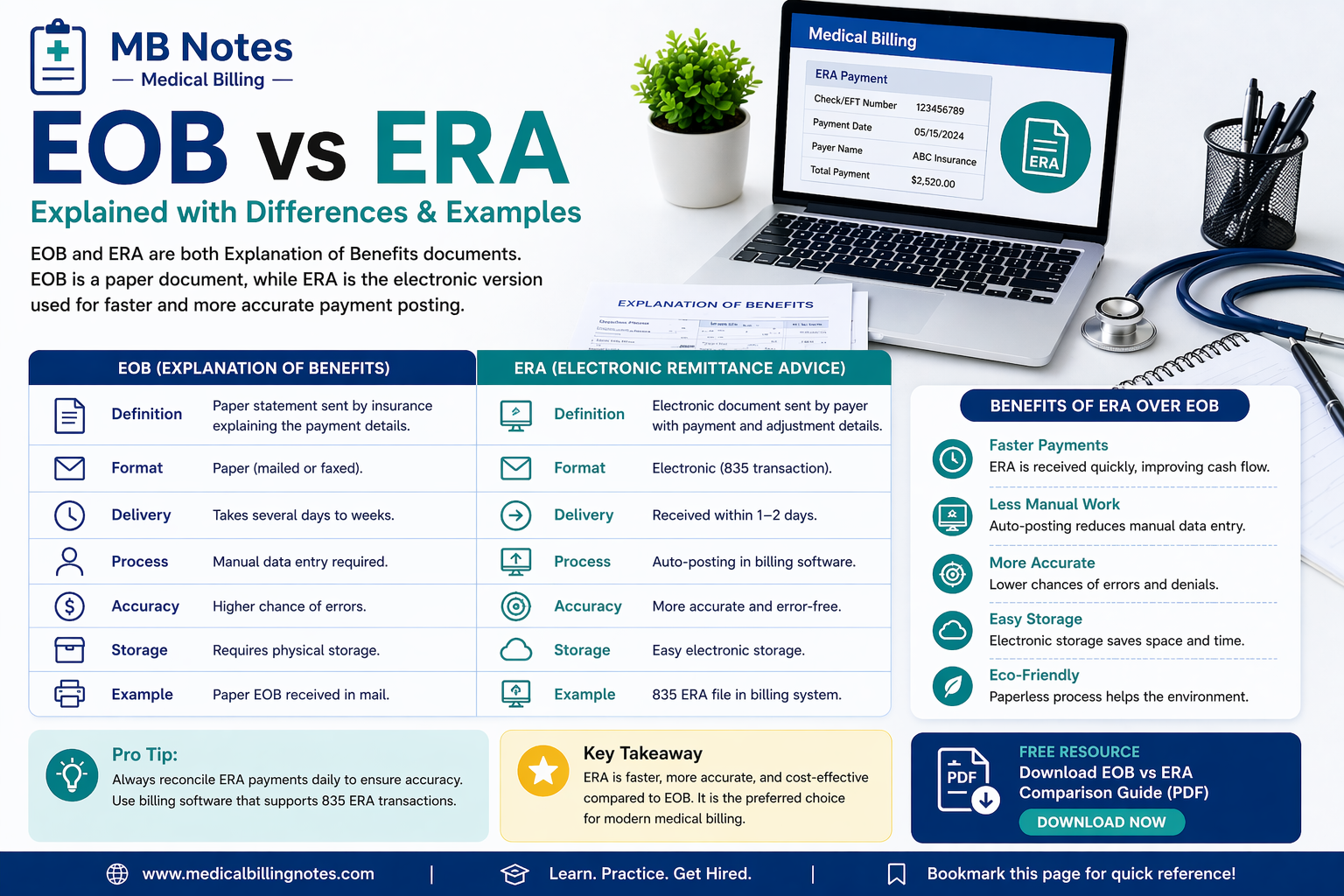
EOB vs ERA Explained: In medical billing, both EOB (Explanation of Benefits) and ERA (Electronic Remittance Advice) are documents that explain how a claim was processed and paid. An EOB is a paper or PDF statement sent by the insurance company, mainly for the patient and provider, showing billed amount, allowed amount, payment, adjustments, and patient responsibility. An ERA is the electronic version of this information, sent in a standardized digital format (ANSI 835) directly into billing software for faster and automated payment posting.
The importance of EOB and ERA lies in accurate payment posting, reconciliation, and denial identification. In the United States, under systems governed by the Centers for Medicare & Medicaid Services, ERAs are widely used to speed up revenue cycles and reduce manual errors. In Asia and the Middle East, where some providers still rely on manual processes, EOBs are common, but ERAs are increasingly adopted for efficiency. These documents help billing teams understand how much was paid, why deductions were made (using denial or adjustment codes), and what balance remains for the patient.
To manage medical billing effectively, billing agents, payment posters, and billing companies must carefully review EOBs and ERAs. For ERAs, ensure proper auto-posting setup and validate that payments match bank deposits. For EOBs, manually enter data accurately, including payments, contractual adjustments, and patient balances. Always review denial codes and remarks to identify issues for A/R follow-up. Regular reconciliation of payments with claims is critical to avoid revenue leakage. Maintaining updated knowledge of payer rules, using billing software efficiently, and performing audits can improve accuracy. Ultimately, proper handling of EOB and ERA ensures correct financial tracking, faster collections, and a healthier revenue cycle.
🧾 1. What is EOB (Explanation of Benefits)?
Definition: An EOB is a paper or PDF document sent by the insurance company explaining how a claim was processed.
👉 It shows:
Billed amount
Allowed amount
Paid amount
Adjustments
Patient responsibility
💻 2. What is ERA (Electronic Remittance Advice)?
Definition: An ERA is the electronic version of EOB, sent directly into billing software in a standard format (ANSI 835).
👉 Simple meaning: ERA = Digital EOB (faster + automated)
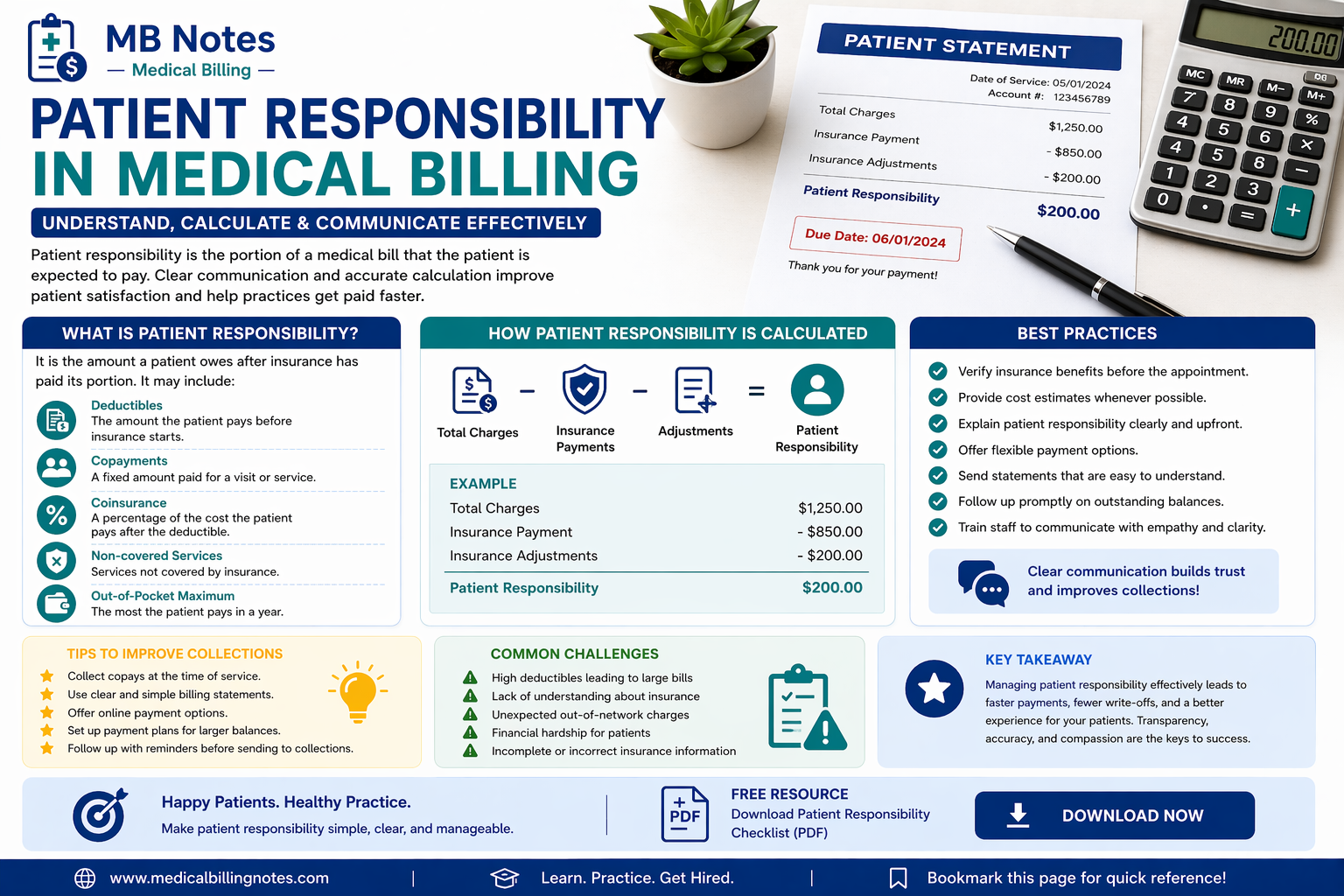
Patient Responsibility:in medical billing refers to the portion of healthcare expenses that patients must pay out of their own pocket after insurance has processed the claim. This amount may include deductibles, copayments, coinsurance, non-covered services, or charges applied due to out-of-network treatment. Understanding and managing patient responsibility is an essential part of the healthcare revenue cycle because it directly affects a provider’s cash flow and patient satisfaction.
The patient responsibility process begins with insurance verification and benefit eligibility checks before the patient receives medical services. Medical billing agents verify the patient’s insurance coverage, copayment amounts, deductibles, and coinsurance obligations. After the healthcare provider submits the claim to the insurance company, the payer processes the claim and issues an Explanation of Benefits (EOB) or Electronic Remittance Advice (ERA). These documents clearly indicate the amount paid by the insurance company and the remaining balance that the patient is responsible for paying.
The patient responsibility process begins with insurance verification and benefit eligibility checks before the patient receives medical services. Medical billing agents verify the patient’s insurance coverage, copayment amounts, deductibles, and coinsurance obligations. After the healthcare provider submits the claim to the insurance company, the payer processes the claim and issues an Explanation of Benefits (EOB) or Electronic Remittance Advice (ERA). These documents clearly indicate the amount paid by the insurance company and the remaining balance that the patient is responsible for paying.
Medical billing agents, AR callers, and medical billing companies play a critical role in managing patient responsibility. They must carefully review EOBs and ERAs, post payments accurately, generate patient statements, and communicate balances professionally. AR callers should contact patients to explain their financial obligations, offer payment options, and resolve any billing disputes. Maintaining proper documentation, following payer guidelines, and complying with HIPAA regulations are also essential responsibilities.
Medical billing agents, AR callers, and medical billing companies play a critical role in managing patient responsibility. They must carefully review EOBs and ERAs, post payments accurately, generate patient statements, and communicate balances professionally. AR callers should contact patients to explain their financial obligations, offer payment options, and resolve any billing disputes. Maintaining proper documentation, following payer guidelines, and complying with HIPAA regulations are also essential responsibilities.
🧾 1. What is Patient Responsibility?
Definition: Patient responsibility is the amount that a patient must pay for healthcare services after the insurance company has processed the medical claim. In simple terms, insurance does not always cover 100% of medical expenses. The remaining balance becomes the patient's responsibility.
👉 Patient responsibility may include:
Copayment (Copay)
Deductible
Coinsurance
Non-covered services
Out-of-network charges
Penalties or policy limitations
Understanding patient responsibility is essential for medical billers, AR callers, healthcare providers, and patients because it directly impacts revenue collection and patient satisfaction.